

There’s no sense upgrading components until you’re making the best of what you have.
When setting up your hifi, often, the speakers end up in purely practical positions, rather than what sounds best.
However, to get the most out of your precious hifi, you really need to place the speakers correctly. If you’ve never tried this before, you’ll be amazed at the difference it can make. The best part? This upgrade won’t cost a cent – just a Sunday afternoon (plus, perhaps, some convincing of your significant other), and some extra tweaking over time.
Distance from the walls #
The first thing to consider is the distance from the walls in the room. The closer a speaker is to a wall – whether that be floor, ceiling, side, or, most noticeably, rear – the greater the bass reinforcement.
Speakers are generally happiest at least 30-60cm from a rear wall, but your manufacturer may tell you otherwise (if you have manuals for your speakers it’s good to check them for info on recommended placement).
As a speaker is moved further away from a wall, the soundstage (the sense of where the musicians/instruments are sitting in front of you) will become deeper, and the bass lighter. However, move them too far away, and you’ll lose focus. So, to start, place the speakers as far out from the wall as is practical for your room (around a metre ±50cm is good), but make sure that both are the same distance from the rear wall (to about 1 cm).
You should also keep your speakers a similar distance from your side walls, too. Note that I said similar distance: having your speakers the same distance away from both a side wall and a rear wall will actually degrade the sound, so make sure the distances differ, but that both fall within a 30-150cm range.
Also, ideally (although it’s seldom possible) you want your left and right speakers to be in a symmetrical position – that is, both equally as far from their nearest side wall as each other.
Distance from you #
Now that your speakers have a placement that is sympathetic to the shape of your room, you need to find where to place your listening seat – after all, it’s no good having the ‘sweet spot’ of the sound being away from your ‘comfy spot.’
You should set the room up so that your chair is positioned at the apex of an equilateral triangle, with your speakers being the points. It’s actually surprisingly important to have the left and right speakers equally as far from you – even a difference of a few centimetres can throw off the whole image.
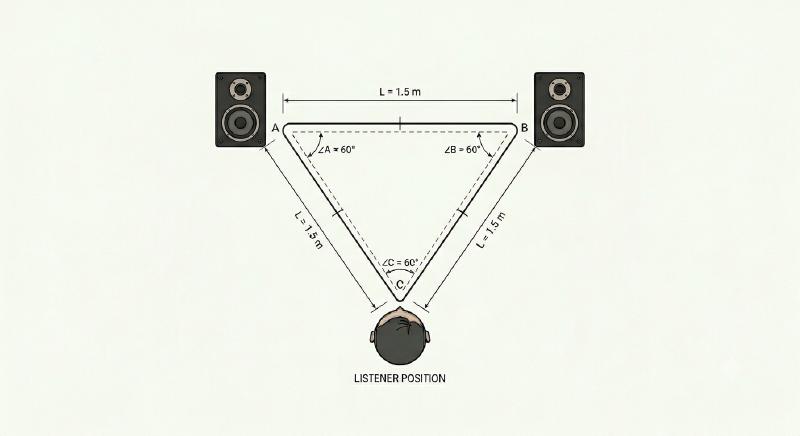
The best way to make sure that you have the speakers equidistant from you and each other is to cut two pieces of string so that they are the same length as the distance between your two speakers. Next, mount each piece on the same position of each speaker (say, the inner top corner), and where the two pieces meet will mark the line of your sweet spot.
Now, if this happens to lie in a place where a chair would be impractical, don’t fret – there is a bit of back and forth give here (equal to about half of the distance between your speakers). In fact, you should experiment with moving your sweet spot back or forward – in some rooms, it can help alleviate any ‘boomy’ bass.
If you still can’t place a chair in your sweet spot, you may have to move your speakers closer together to bring that sweet spot forward.
Tuning the room
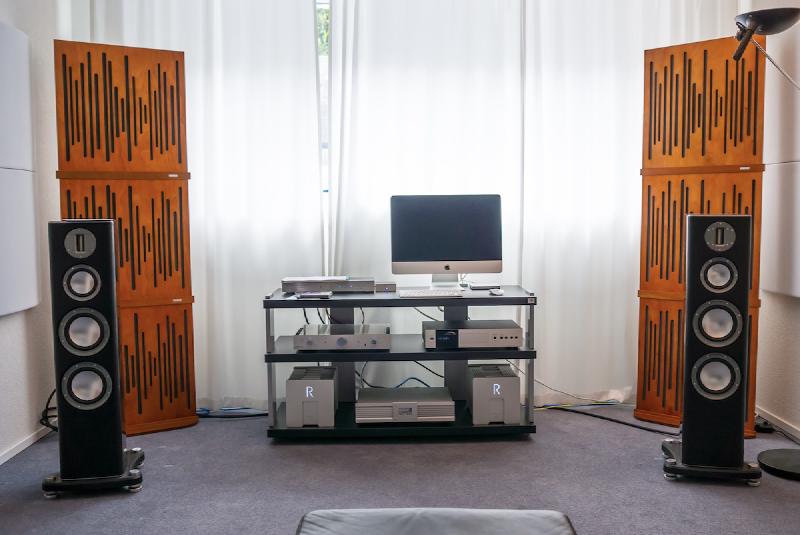
Sound will also be improved by tuning the room. Soft furnishings are your friend – carpet, curtains, or tapestries (if you’re into the medieval vibe), especially behind your speakers, will help remove unwanted reflections. There are also special panels that you can buy from hifi shops designed specifically to prevent reflections. Given the price of these panels, however, bachelors may prefer instead to stick egg cartons to their walls.
Fine tuning #
Once you’ve nailed the general placement of your speakers, it’s time to test them out and get to the fine-grained tweaking. In choosing a song/album to test them out with, you’ll need one that you’re very familiar with, but also recorded well. It’s preferable to pick recorded music, rather than electronic, as its soundstage – as well as any tonal colouration – will be easier to pick out. You should also disable any equalisers or tone controls.
Height #
The first thing to fine-tune is the height of the speakers. Ideally, you want your speakers at a height so that your ears line up with the midpoint between the tweeter (the tiny little speaker) and the first speaker below it.
You can experiment with different heights for bookshelf (non-floor-standing) speakers by placing them on the different steps on a ladder, or by adding books underneath – just make sure that both speakers are the same height as each other. If you really care for sound, you can fork out for height-adjustable speaker stands.
If you have floor-standing speakers, then you are pretty much stuck with their height, so consider adjusting the height of your chair, if possible.
Angle (or toe-in) #
Angling speakers towards the listener is known as ’toe-in’, but most speakers are designed to be placed perpendicular to the listener – in fact, in writing this article, I straightened a pair that had been angled towards me for years, and the improvement in soundstage was dramatic.
If your speakers were designed to sit at an angle towards the listener, it will be noted in the instruction manual. If you don’t have a manual, then start with the speakers flat. After listening to some music and becoming familiar with their sound, gradually angle them towards you and decide if it makes any improvement or not.
As you turn your speakers in, it should have the effect of increasing the focus of each instrument, but narrowing the overall soundstage.
You will want both speakers to have the same angle, and you can either use the string method again, but this time measuring the distance to both front corners, or you can place a laser pointer in the middle top of each speaker, and place a cardboard tube (or other object) in your sweet spot, and make sure that the laser hits the same spot from both speakers. Needless to say, don’t let anyone sit in the sweet spot while you do this.